Showing posts with label City of London. Show all posts

Tuesday, 15 May 2012

Alt. Events: Occupy Bank of England

Location: Bank, London


This is one of the more unusual situations to find oneself in, but it is not necessarily something to snub as a form of anarcho-tourism. One does not get to experience the feeling of stumbling in to the middle of an organised protest, particularly one demonstrating against wealth hoarding and capitalism.
In this case, one has to carefully make their way through lines of policemen, watching the proceedings in groups of three to four, as loud speakers blare out various conflicting noises.

Even within the protest itself, there is an obvious segregation of different groups with their own agendas, with one particularly standing out is the 'Anonymous' group, which seems to bear a certain irony, but no less has their agenda to mind.

This demonstration was a particularly small one compared to gatherings viewed before outside St. Paul's Cathedral, but either way, this summer looks set to continue with these demonstrations occurring at sporadic times. Whether you support their aims, want a free event to mingle with other people, or just want something plain different, this is something that has an intellectual and politcal interest about it, not least for the furor that it is generating from the finance sector, and the City of London corporation itself.

Photos taken and courtesy of the author, a trend that will continue for most future posts.
Disclaimer: The author remains neither 'for' nor 'against' the Occupy Movement or the Met. Police. Though there is no doubt that the demonstrations are of a huge interest, especially outside of the newspaper headlines. It is fully endorsed to interact with members of the demonstrations.

Friday, 13 April 2012

London Walks: Canal walk from King's Cross to Camden

Start: York Way, King's Cross, London
End: Camden Market, Camden Town, London

The walk along the side of the canal just north of King's Cross and St. Pancras stations is not only a nice direct way to walk to Camden town, but it is also one of the more interesting views of London. The canal snakes its way around the north of the city, past both industrial and natural scenery.
Along this walk, one will come across a great number of canal boats moored along the side. Canal boats are a major feature of London's waterways, and many serve as homes, while others are available for hire to drive along the canals. This is a great way to spend a day, coasting along at a quiet pace, taking in the scenery of inner London without the constant roar of traffic.


However, no matter where one goes, one does not feel that they have left the city behind, and there is always the background of the city beyond the trees, whether it is the sounds of traffic or trains. Bird life however thrives in this environment, with songbirds and many others in the branches above the water, to the numerous ducks, geese, and swans.
As one walks further along, a certain tranquility is apparent, as the city noise is minimal, and more trees and greenery dominates the scene. However large warehouses and flats are seen, a constant presence of the city, but with the rest of the vista on offer, these become background blemishes.
One destination worthy of note is the Constitution pub, that sits overlooking the canal, with a sizable beer garden. This is one recommended venue for a halfway stop along the canal, and will be covered here at a later date.
The walk goes on from there, through a number of bridges, when the sun is in the right position, creates mesmeric reflections on the inner arches of these 'tunnels'.
Through these arches, the numbers of other walkers starts to increase sharply, with many walkers, picnickers, and cyclists crowding out the more narrow parts of the footpath. Soon however, Camden market starts to make itself apparent, as the numbers of other people keep soaring.
 As one gets nearer, one starts to go past the locks in Camden, and if one wishes, can pass underneath Camden and continue onwards. However this journey made it to Camden, and no further.
This is the start of a series of articles on London walks, as an activity, as well as a means of capturing some interesting sites around the city that are not on the tourist trail. Sunny summer days are most recommended for this, though be aware that many others will have the same idea. That should not dissuade one at all, as these days are recommended for good reason.

All photographs were taken by the author, and all souls captured on film will be refunded at no extra cost.

Friday, 9 March 2012

Serpentine Gallery, London


Location: Hyde Park, London

This surprising find is found in the heart of Hyde Park, a faux classical building lies nestled amongst the trees of the park. The Serpentine gallery is aimed at providing free art exhibitions with an educational point of view.

Going inside, the first room opens up with a display of step ladders with various instruments stuck to them. Designed by a musician, it displays all the instruments that were used in the band.
Beyond that, there is a film theatre, showing a variety of different films, not very well known films and by independent producers. In particular, the film on was called Fulll Firearms, by Emily Wardell, and it was full of interesting and well-shot scenes, and a lot of emotion involved in each scene. Art was featured throughout in all its forms, from painting, to clothing, architecture, poetry, and song.

Moving through, the next large room featured a number of props, with a cage on one side, knots of cloth knotted round the bars with english and arabic writing on. On top of the cage were female cloth dolls, and below were a few cloth houses, words sewn on them spelling out 'Made in Egypt'.
A tent dominates the center of the room, with pictures of people, and arabic writings, all below the letters 'KFC', and in front of the tent was a cushioned mat with words written over it, and the author's signature in the corner, Khalil Gibran.
A table is at the far end of the room is a table with three television sets around it, each showing short films done by students and young filmmakers of No.w.here free cinema school. The first film was of scenes of Edgeware road, and of pieces of art around London, most of which featured a particular girl as if in a typical daily setting. The next features a man, covered in newspaper clipping, head to foot, walking around and greeting people on the street, shot in black and white, with a grainy old-style.
Last was of London street scenes, of the Edgeware road area, and slogans would appear up on the screen, in an almost mocking fashion, such as 'morality' and 'crime & punishment'. The film far more clearly shows the current issues of paranoia and terrorist threats in a mocking light, with words such as 'everyone is a terrorist' against a typical street market scene.

The rest of the room has a variety of wall mounted television screen, all showing other short films and documentaries on life in Egypt, highlighting the variety of issues that plague the country, or as a cultural setting. Amongst these are a set of five painting by Marwan Rechmaoui, paintings of street maps in various style, in a mock child-drawing fashion, with arabic writing for street names and locations.

Following this, the next room on the otherside of the building, starts with a poem called 'Maps, oh maps' by Etel Adnan, and the adjacent wall features lots of VHS cassette tapes stuck to the wall in ad hoc fashion, with the caption reading that they are all fragments of the film called 'the three disappearances of Soad Hosni'.
This leads to another large room, where the nearest display is a collage of photos, most of generic objects in London, with the middle set of photos showing different people in the background, and the foreground of a young person holding a hand-drawn placard with words describing the people in the background, such as 'tourist', 'travellers' and 'business talkers'. Next is a poster titled '/ Protocols for Poem Objects /', with a variety of categories below, and examples in poetry form for each. Next to this was a table with a number of books, collections of poetry by various authors.
The opposing wall features a large poster of text from the 'Bidoun library', and interspersed throughout are several books, stuck by their spines to the poster, pages opened out naturally.
Finally, at the end of the room was a projector displaying a short film of conflict and life in Egypt, in a mock-documentary form, using children as actors to show people and soldiers in states of travel, conflict, and burial. The aim of this, as explained by the caption was to challenge the social structure by its use of children to show some of the harsh realities of life in Egypt.

The final room, at the back of the building, has a few displays, first being a collage of photographs, stories and captions by CAMP, of various controversial publications in the history of Edgeware road. There were also two televisions of different short films, first was on the close of the last pub in Edgeware road, and some words displayed on the screen between scenes about why. The other showed an arabic comedy with subtitles.

This was a rare find, and worth going to see, not least because it costs nothing. It is within Hyde Park itself, and makes for an excellent diversion during a walk through the park, away from the busy streets of London itself. It is educational in its own way, showing facets of Egyptian life, conflict and culture, and the film theatre is an excellent place to spend some time watching thought provoking films.

Images courtesy of theWhatWhereWhen and the Serpentine Gallery websites.

Saturday, 25 February 2012

Three Centuries of British Art, Tate Britain


Location: Tate Britain, London

For the second visit to the Tate Britain, the emphasis here is on a single room of a gallery. The main entrance room to the Harry and Carol Djanogly Gallery, though unlike the National Gallery, the paintings within this room are of a range of periods.
The room is a large, rectangular gallery, with a high arched ceiling in white, covered in plaster decorations, especially the round flower shapes within square frames. The walls are of a dark grey, which comes as not dull in any regard, but focuses the visitor on the paintings themselves.
The paintings cover a range of centuries of British art, from the late 1500's Elizabethan art, to the late 1800's. The room covers three centuries of art, with some excellent examples of style and the impression of the dress at the times.

Moving to the art itself.
The starting at one of the room, and working his way round, the author made note of some paintings on the basis of how much they had caught his eye.
First was called Portrait of the artist's wife by William Dobson in 1635-40. Eye catching for an entrance, the artist had captured so much detail about his wife, and how she looked through his eyes. She does show as a beautiful woman in it.
Next, An Allebgory of Man by the British school of the 16th century painted this in 1596. A religiously centered piece, it is regarded as a painting of excellent detail, and content, with a prayer on the bottom.
The Portrait of Mary Kytson done in 1590 by the British school again, was chosen as one very good painting of thje style of dress worn by high society.
The Portrait of Sir William Killigrew, was done in 1638 by Anthony van Dyck. Van Dyck's style was noticeably different from the others here, as he had a much softer way of painting, and an eye for setting up interesting features in his backgrounds, such as that of the trees on the side in this painting.
Next is the accurate rendition of Queen Elizabeth I, painted over 1572-5 and attributed to the work of Nicholas Hilliard. This piece is one of the very famous pieces depicting this queen, and this one in particularly was not just exquisite for the details of Elizabeth's features, but also how extravagant Elizabethan dress can truly be.
Moving on, The Dance by William Hogarth, done in 1745, was less detailed compared to many of the neighbouring paintings, but it was a highly dynamic scene of a party, with people socialising and walking around. What was also very noticeable is that it gave an overview of the styles of attire worn in high society parties during the 18th century.
The Portrait of an Unknown Woman by Peter Lely, from 1670-5, was eye-catching on a cruder scale. It showed a beautiful woman staring at the painter, with one bare breast, and an almost inviting expression on her face.
Halfway along, the next piece worth looking at was the Pomeranian bitch and puppy by Thomas Gainsborough in 1777. It makes for a return to the Romantics the author covered at the beginning of this, and is noticeable for the focus on the dogs, with excellent detail, even down to emotive expressions. The background is less detailed, of a more flowing quality.
Next, the Lady Bate-Dudley done in 1787 by Thomas Gainsborough again, remarkable here for the exquisite and elaborate dress worn by the Lady, of white and blue, which contrasts greatly against the dark background.
Moving further, the next is a selection of paintings called Past and Present, a series of three paintings Augustus Leopold Egg in 1858. All three paintings are dark and feature scenes of melancholy and sadness in various forms.
The Lady of Shalott by John William Waterhouse in 1888, is a particularly well known painting, though considered against much of the rest of the collection, it is not that good. What is worth remarking is the expression captured of the Lady in the painting.
Here, two paintings by John Everett Millais, Ophelia (1851-2) and The Boyhood of Raleigh (1870). While in no particular way, these two pictures contrast against each other in colour, the former in green, the latter in a sand and blue colour, but what they both share are exquisitely captured central scenes, with the expressions captured, Ophelia's despair, and Raleigh's childlike curiosity.


While continuing with the next painting, the Monna Vanna, done in 1866 by Dante Gabriel Rossetti. While there has been a growing expression of passion throughout the paintings so far, in this, Rossetti shows great passion in his painting to the point it shows through, even if the painting itself does not contain anything much beyond that of a beautiful woman.
Next, introducing one by William Holman Hunt, the Awakening Conscience from 1853, strikes out as another interesting, and eye catching painting. Though the expressions are captured brilliantly in this, what was particularly noticed was certain details noticed, such as the scene reflected in the mirror.
Ellen Terry as Lady Macbeth, by John Singer Sargeant in 1889, is a large, flowing painting, but shows a great scene of an actress, with her long red hair down the front of her blue and green costume.
Marianna done in 1851 by Millais, another great example of the level of detail put in to the painting.
Now for the last stretch, starting with The Derby Day by William Powell Frith, 1856-8, is a very busy scene now the races, showing a panorama filled with punters. Excellently detailed, and a large painting.
The Rome: St. Peters and the Vatican by Richard Wilson in 1753. This is a spendid and calming scene of room at this time, from a distance. There it shows the Vatican in the distance, surrounded by the hills of Rome, in summery colours.
Last is Colonel Acland and Lord Sydney: The Archers from 1769. This piece by Joshua Reynolds is a very well-centered and dynamic painting, showing a composition the central two characters on a hunting mission. The colours are well used, with darker ones for the background to contrast the pale central figures.

This was very good room for spending a good deal of quality time in exploring a vast range of British art. Covering three centuries in a gallery containing some of the very best of British art, it contains a few famous masterpieces, and is also a very good glimpse in to painting styles and the clothes worn by people throughout this time. Following the list route here was necessary to present a careful selection of some of these paintings. However it is by no means comprehensive, and there is always so much more on offer from the Tate Britain.

Images courtesy of Travel Guide London, and the Tate Britain

Wednesday, 15 February 2012

London pubs: The Salisbury pub


Location: The Salisbury, London

Located deep in the heart of London, this gem of a public house is located near to Leicester Square station, in the center of London's entertainment and tourist area, a constantly bustling quarter of the city, giving it that high, charged atmosphere, highlighted by the brightly lit and neon signs for the wide variety of shops and theaters.

The pub itself is of a trend of public houses maintaining the vintage and antique designs of early pub heritage, one of the most iconic and distinctive characters that London and the UK as a whole is known around the world for.
The pub has a dark exterior, with the trademark sign hanging outside, and large patterned windows around it. There are a couple of entryways, both maintaining the exterior style, and equally giving an impression of the venue interior.
Entering through one of these, one is met with a vision of vintage style, with a large curved bar in the middle of dark wood displaying a range of beers on tap lining the inner edges. Behind the bar is the spectacular shelving of a very dark wooden frame, elaborately decorated, with curved arches framing mirrors of more etched patterned glass. On the shelves, the pub displays many of its other wares, bottles of wines, and spirits of a wide variety of well known names.


The rest of the bar is no less appreciable, with seating lining the walls, several booths of semi-circular cushioned sofas in a dark red colour tastefully lit up highly ornamental orange lighting, emphasising the dark, warm atmosphere of browns, reds, patterns and brass metal coat hangings. The windows at the entrance side, which during the day, daylight infuses the area with a gentle white ambiance, making it an ideal reading area.

Apart from the main bar area, leading through to the dining room. This medium sized room accommodates several dining tables of varying sizes, lined with chairs and green coloured cushioned benches against the walls. The walls themselves follow the style of the rest of the pub, with carved dark wood frames and patterned mirrors to reflect the light around evenly.
Even the stairway to the toilets is worth it for what greets the visitor. The walls all the way down are lined with countless overlapping posters for the various plays and acts that have graced the West-end theaters of London, going way back to times long past up to the current stage performances.
From opening, the pub sees a steady stream of customers coming in, starting with regulars, and building up to groups of both regulars and visitors, which by lunch time ensures an atmosphere of a bustling social centre, before quietening down mid-afternoon for solo drinkers and couples having late lunches. Music plays throughout the day, a variety of classic rock hits and the occasional pop tune.
Overall an excellent place to come for a drink, either on one's own, or as a group, the range of beers are generally of a good quality, from the well known lager brands, to Belgian beers, and a choice selection of both popular and guest ales. If alcohol is not an option, there is always the coffee available, as well as a range of soft drinks and fruit juices.
For those who long for a special sense of style and history, there is also an image of Marianne Faithfull reclining on one of the side sofas, as also given below.

Images courtesy of pubs.com, the BBC, and Time.

Saturday, 11 February 2012

Impressionism & Post-Impressionism, National Gallery

Location: National Gallery, London

On this visit to the National Gallery, the main focus was to tour a collection of rooms that were briefly looked at on the previous visit. Now for a review of the National Gallery's collection of Impressionist and Post-Impressionist paintings.

Of the rooms concerned, they have a simple décor, with plain brown-grey painted walls, plain white ceilings with some nicely crafted decorations and some windows to give air and light. As for lighting in general, there are plenty of spot-lights dotted around, giving plenty of light to see details. All this amounts to rooms with a complete focus on the exhibits only.


The Harry and Carol Djanogly room.

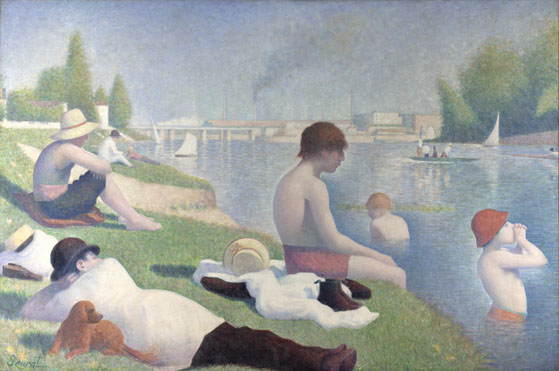
This room opens out, in the middle of this series of four, with nothing short of the 'Bathers at Asniéres' surrounding by a small portfolio of smaller pieces by Georges Seurat, including his studies for the Bathers. All of these show off his calm use of colour, and particular dotted style of painting that composes the scene. The centre-piece itself gives off a particularly tranquil feeling, depicting a scene of calmness in all the people shown.


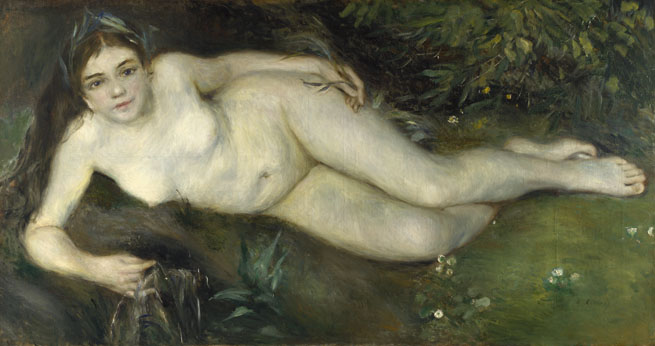
While Seurat was certainly the centre of attention here, the room has quite a number of other paintings on display of other famous painters of the period, starting with none less than Renoir, and a flurry of vivid and colourful paintings. 'Nymph by a stream' was an eye-catching example for both its use of contrasting colour, the dark green background to the pale nude model in the centre, and classical mythological aspect, followed by the wide range of soft colours in 'Dancing girl with tambourine', and 'Misia Sert', the former gives a dynamic feel of movement, while the latter shows a still model with a relaxed look.


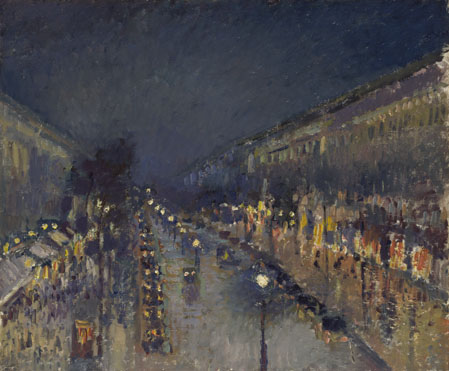
Last notable artist in the room was Pissarro, with a selection of landscape scenes, with the exception of his 'Portait of Cézanne'. There were a few paintings of cottages and country landscapes in both France and England, one example being 'Fox hill, Upper Norwood', there was also the 'Boulevard MontMartre at night', though it lacked its day time counterpart here.


Monet, Manet, and Impressionism

The second room of this tour takes one through another selection of the famous, though by reading the introduction, one gets the impression that these artists were seen as infamous within artistic circles. After that, one then should gain a considerable appreciation of the efforts these artists expended in embarking on an artistic style that alienated them from the mainstream.

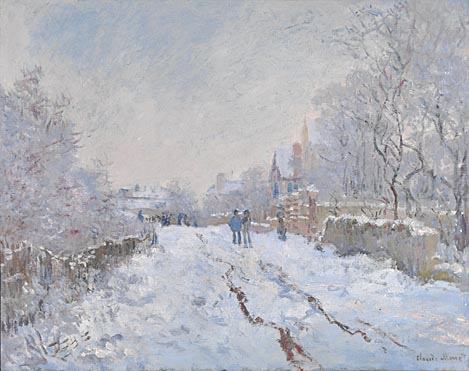
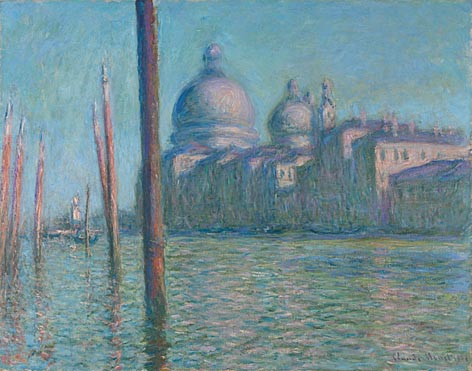
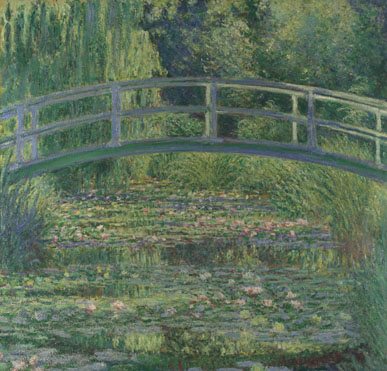
Monet was the first one on this tour, with his use of bright colours, and quick brush strokes. There were quite a number of excellent scenes, but a few really do catch the eye, such as the sombre coloured 'Thames below Westminster', the winterscape titled 'Snow scene at Argenteuil', and 'The Grand Canal, Venice'. There was also a selection of vivid garden scenes, comprising of the famous 'Water Lily pond' next to the smaller 'Water Lilies, setting sun'.


Now if one goes across the room, or will be just made aware of the rest of Monet's paintings in this room, more landscape scenes such as the sunny 'La Pointe de la Hève, St. Addresse', dark and smoky 'Gare St. Lazare', and the almost fluidly painted scene 'Bathers at La Grenouilliere'.

Moving on, there are the more subtle colours of Sisley in 'The watering place at Marley-Le-Roi', 'The small meadows in Spring' and 'The Seine at Port-Marley'. All excellent examples of another major Impressionist, despite not necessarily the first to spring to mind.

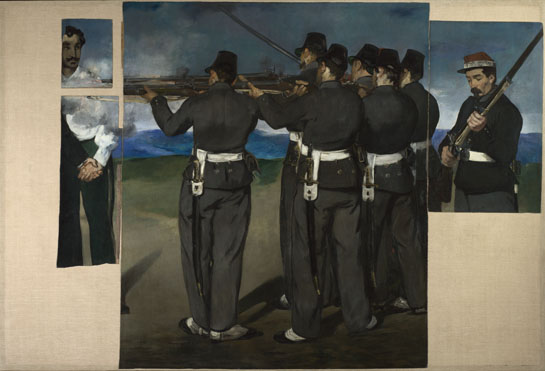
Manet's collection here was small by comparison to Monet's, and yet he still has some truly stand-out pieces for the visitor. There is 'Eva Gonzalès', 'Corner of a café-concert', not to mention the opposing centre piece to Monet's 'Water Lily pond', the reassembled 'Execution of Maximillian'. What marks out Manet distinctly then was his was of capturing people and their expressions in Impressionist style.


Van Gogh and Cézanne

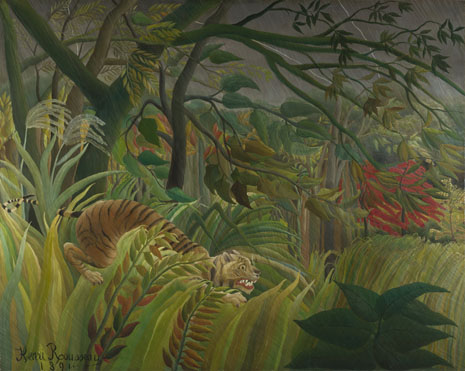
Third on this visit, which if the visitor follows the route from the previous two rooms, would be greeted by the Post-Impressionist painting 'Surprised' by Rousseau. It is a fine piece however, lending expression to the stalking Tiger in the foreground, and a florid jungle scene around it. The painting style is very different too, with long, careful, deliberate strokes, and earthy colours.


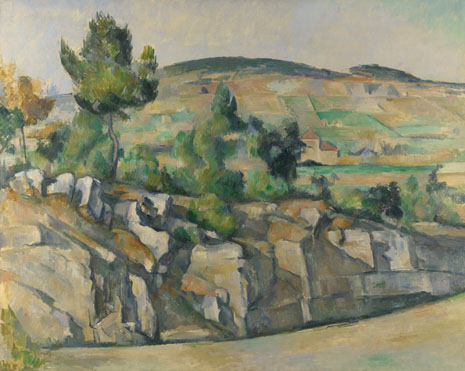
This leads nicely on to Cézanne's paintings, which seem to incorporate a range of rich colouring, with long firm brush strokes, rendering his paintings the feeling of deliberation. His paintings are of a more balanced range, with the life pictures like the 'Bathers', displaying symmetry and blending of man and nature, the bright and calm 'Hillside in Provence' showing an idyllic Mediterranean scene, and other notable paintings, 'Avenue at Chantilly' and 'Landscape with Poplars', both of these are very green examples, the latter makes for a wonderful scene from Provence.


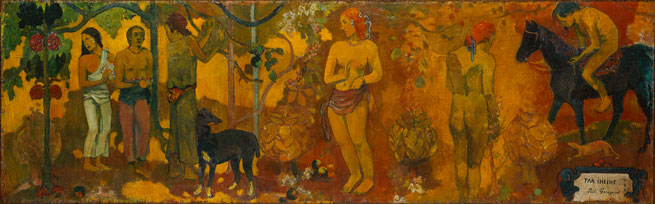
After Cézanne, Gauguin, with his earthy colours, and deliberate painting style. This room had a few of his, one particularly interesting example is 'Faa Iheihe', with it's imagery of Tahitian women and men. The other two interesting pieces of note here is 'Still life with mangoes', a plethora of exoticism, arrayed out in the form of mangoes, as it would have appeared back 1896 when the painting was finished, and 'A vase of flowers', which unlike many previous examples is not likedr any interest in the character of the subject, but purely in the details of the flowers and the colours used in their composition.


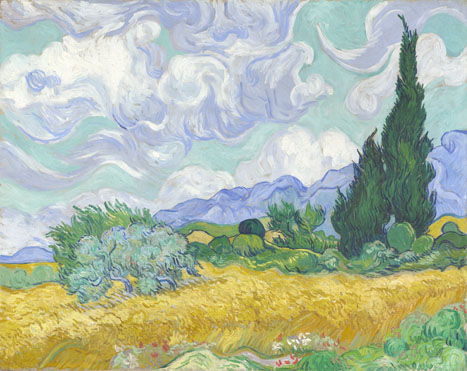
Last, but not least, Van Gogh with his rich, bright colours, and quick brush strokes, known over the entire world, and at the centre of his display, the iconic 'Sunflowers'. Admittedly still life is not particularly endeared to the author, however it is difficult not to appreciate the style of this piece, and the colours used. Surrounding this, other pieces worthy of mentioning would be the richly detailed 'Two crabs', and 'A wheatfield with Cypresses' with its impressive view.


Degas and Art around 1900

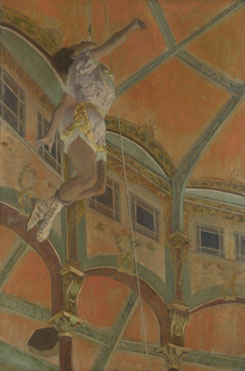
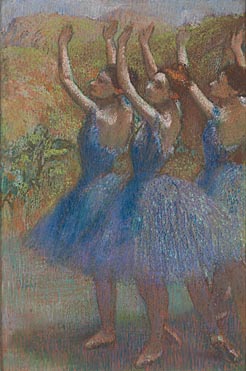
The last room on this tour centres on Degas, with an array of scenes, many with models in them, including all the eye-catching examples of note, 'After bath, woman drying herself' as the subtle use of nudity gives it its eye-catching quality, to the feat of strength captured in 'Miss La La at the Cirque Fernando'. However the very best were the dynamic paintings that feel like they had captured their movements as in photographs, 'Russian Dancers', 'Three Dancers in violet tutus', and 'Ballet Dancers'.


Apart from Degas, there was a range of paintings, one or two per artist scattered around the room, giving views of the time, as seen through their eyes, but there was the large and beautifully rendered 'Terrace at Vasouy'. Originally painted as one in 1901, and later split in to two halves, 'The Garden' and 'The Lunch', with extra people and details added to complement each singular half, in 1935.

This concludes the tour of Impressionism and Post-Impressionism as on display in the National Gallery. It was a fairly length one at that, comprising of four rooms in the gallery, each one containing dozens of fantastic paintings and some documentation of their times. As part of the permanent collection, there is no particular rush to see them, but in one's lifetime is as good a time as any.

Images here are courtesy of the National Gallery.

Wednesday, 8 February 2012

London in the snow

Location: Arsenal, Highbury, Islington, London Bridge, Tower Bridge, London

Warning: This post contains judicious image usage and dry humour.


This is an event that occurs fleetingly at any point during the year. Large quantities of settled snow like this are unexpected to say the least, and only up to a week in advance can forecasters predict it with even moderate accuracy.
Usually remarked as a time of intense cold, slippery pavements and infrastructure issues, the tone of this is to bring out the reason against staying inside in comfort. It is something that should be embraced for its sudden appearance, and disappearance soon afterwards, as something that brings joy to children, even childish adults, for fun games, and spectacular views.

In this case, here is a gallery of photographs taken on a trip from North to Central London.

One of the many snow-covered streets in Arsenal.

One view of the Unity church in Highbury

Islington green, not so green.

View of the incomplete Shard tower at London Bridge. Currently the top is obscured by the low cloud.

The North-west side of the Tower of London.

Far off view of Tower Bridge along the side of the Tower of London.

View of one of the docks in St. Katharine's Docks

Some of the larger boats in the St. Katharine's Docks

A large yacht.

View over another dock.

A more side-view of Tower Bridge.

A view down Tooley street. In many of the busier streets like this, there was hardly any snow left by Noon.
A peek out from the South bank, across the Thames. The footpath along the Thames was very snow-covered.

Looking back at Tower Bridge from the same bank as the previous image.

While hardly snow-strewn, the Hay's Galleria always makes itself presentable for the budding photographer in London.

Statue supposedly of Julius Caesar. This is found right by the Tower Hill tube station.
All these pictures were taken on a mobile phone camera.