Showing posts with label Artifacts. Show all posts

Friday, 9 March 2012

Serpentine Gallery, London


Location: Hyde Park, London

This surprising find is found in the heart of Hyde Park, a faux classical building lies nestled amongst the trees of the park. The Serpentine gallery is aimed at providing free art exhibitions with an educational point of view.

Going inside, the first room opens up with a display of step ladders with various instruments stuck to them. Designed by a musician, it displays all the instruments that were used in the band.
Beyond that, there is a film theatre, showing a variety of different films, not very well known films and by independent producers. In particular, the film on was called Fulll Firearms, by Emily Wardell, and it was full of interesting and well-shot scenes, and a lot of emotion involved in each scene. Art was featured throughout in all its forms, from painting, to clothing, architecture, poetry, and song.

Moving through, the next large room featured a number of props, with a cage on one side, knots of cloth knotted round the bars with english and arabic writing on. On top of the cage were female cloth dolls, and below were a few cloth houses, words sewn on them spelling out 'Made in Egypt'.
A tent dominates the center of the room, with pictures of people, and arabic writings, all below the letters 'KFC', and in front of the tent was a cushioned mat with words written over it, and the author's signature in the corner, Khalil Gibran.
A table is at the far end of the room is a table with three television sets around it, each showing short films done by students and young filmmakers of No.w.here free cinema school. The first film was of scenes of Edgeware road, and of pieces of art around London, most of which featured a particular girl as if in a typical daily setting. The next features a man, covered in newspaper clipping, head to foot, walking around and greeting people on the street, shot in black and white, with a grainy old-style.
Last was of London street scenes, of the Edgeware road area, and slogans would appear up on the screen, in an almost mocking fashion, such as 'morality' and 'crime & punishment'. The film far more clearly shows the current issues of paranoia and terrorist threats in a mocking light, with words such as 'everyone is a terrorist' against a typical street market scene.

The rest of the room has a variety of wall mounted television screen, all showing other short films and documentaries on life in Egypt, highlighting the variety of issues that plague the country, or as a cultural setting. Amongst these are a set of five painting by Marwan Rechmaoui, paintings of street maps in various style, in a mock child-drawing fashion, with arabic writing for street names and locations.

Following this, the next room on the otherside of the building, starts with a poem called 'Maps, oh maps' by Etel Adnan, and the adjacent wall features lots of VHS cassette tapes stuck to the wall in ad hoc fashion, with the caption reading that they are all fragments of the film called 'the three disappearances of Soad Hosni'.
This leads to another large room, where the nearest display is a collage of photos, most of generic objects in London, with the middle set of photos showing different people in the background, and the foreground of a young person holding a hand-drawn placard with words describing the people in the background, such as 'tourist', 'travellers' and 'business talkers'. Next is a poster titled '/ Protocols for Poem Objects /', with a variety of categories below, and examples in poetry form for each. Next to this was a table with a number of books, collections of poetry by various authors.
The opposing wall features a large poster of text from the 'Bidoun library', and interspersed throughout are several books, stuck by their spines to the poster, pages opened out naturally.
Finally, at the end of the room was a projector displaying a short film of conflict and life in Egypt, in a mock-documentary form, using children as actors to show people and soldiers in states of travel, conflict, and burial. The aim of this, as explained by the caption was to challenge the social structure by its use of children to show some of the harsh realities of life in Egypt.

The final room, at the back of the building, has a few displays, first being a collage of photographs, stories and captions by CAMP, of various controversial publications in the history of Edgeware road. There were also two televisions of different short films, first was on the close of the last pub in Edgeware road, and some words displayed on the screen between scenes about why. The other showed an arabic comedy with subtitles.

This was a rare find, and worth going to see, not least because it costs nothing. It is within Hyde Park itself, and makes for an excellent diversion during a walk through the park, away from the busy streets of London itself. It is educational in its own way, showing facets of Egyptian life, conflict and culture, and the film theatre is an excellent place to spend some time watching thought provoking films.

Images courtesy of theWhatWhereWhen and the Serpentine Gallery websites.

Saturday, 21 January 2012

Sutton Hoo Burial and other sites, British Museum

Location: British Museum, London

The second trip to the British Museum for this blog, this time a return to an exhibit briefly perused during the previous visit.
This side exhibition room is just past one of the museum shops, of which mostly contains a plethora of books, jewellry and other odds and ends at pretty high prices, though are admittedly worth the cost should one find the right gift. However that is not the subject matter at hand.
Past the shop is the main exhibit, a room which is both small and yet expansively opens out for the visitor due to shape and the high ceiling, with dark coloured walls lining the brightly lit room. The center of this room is where the display cases contain the artifacts of the Sutton Hoo burial ground, and other notable artifacts from other Saxon and Viking burial mounds.

Going through these in no particular order, the first display case one would go to would contain the main artifacts, including the iconic Saxon King helmet, and it's intricate features on the mask, which according to the inscription was made up of iron with gold decorations and silvered bronze plating. The old worn helmet is shown, it's colour now resembling a muddy brown and green of corroded iron and bronze, but to illustrate how it must have looked when put ion the mound, a replica was created by the Royal Armoury in the 1970's to show how extraordinary it was, and yet was noted to still be an incredibly practical piece of armour. Next to the helmet is a replica shield adorned with the original metal pommel and decorations or iron and gold which had long outlasted the wood and hide of the original shield, and is noted as being the largest surviving shield of any Saxon burial mound. The rest of this display case also contains other weaponry, from the rusted remains of spears, to a heavily rusted longsword of particular interest as it has shown to have been of extremely fine craftmanship, made up of patterned folded steel, a replicated blade of this sword is shown in another display case, with gold rings around the handle, and finally a corroded mass that had once been a chainmail hauberk.


Moving through the other display cases, there are replicas of drinking horns and bottles with their original gold decorations around, among other pieces that all paint a picture of the long held medieval view of large halls of feasting and drinking, despite the lack of actual evidence behind this. There are gold shoulder clasps for luxurious clothing, other elaborate gold framework pieces, jewellry and precious stone objects from the Frankish kingdom of France, to as far as the Byzantine empire, which during the time, of many other burials sites was at its zenith. There are also gold crosses and objects that show not only the old Saxon gods, but also since they had converted to the early Christianity. All of this changes the perception that the Saxons were far from the commonly held view of being warlike barbarians, but rather in truth they were rich, sophisticated traders and craftsman, and that the nature of luxurious living had changed very little from Roman times through to the early 20th Century, as even the Saxon nobles lived in luxurious clothing and ate extremely well and healthily.
Also from this time, the room contained display cases obtained from Viking burial mounds and celtic sites. The Vikings themselves are shown to be of the same industrious stock as the Saxons, even trading with the Saxons for similar commodities of weaponry, as found in Saxon burial mounds such as the Pentney hoard, and large quanitities of silver-ware, mostly jewellry and decorations, as is found in the notable Cuerdale hoard.


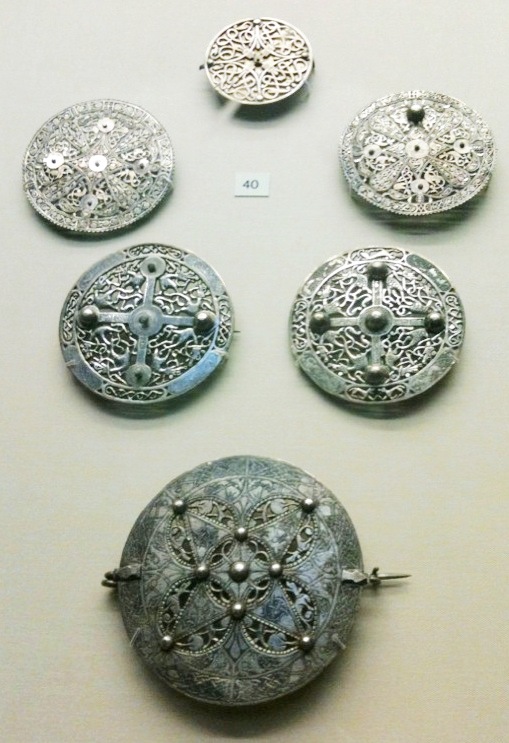
From Ireland, there was Saint CuileƔin's bell, and silver irish brooches, gold Viking jewellry, 'hoard cups' and gold rings. There were some examples shown of Celtic artifacts, bearing their distinctive curvilinear patterns, and many showing red enamelling amongst the metalwork, and even from Saxon sites, evidence of trade with the Celts in the form of copper hanging bowls which were in fact prized by the Saxons.

Lastly of this part of history, there is a collection of Frankish artifacts, and silver-ware from the Martynivka hoard.

One other area of this room which attracted attention is a selection of artifacts that predate the vast majority of ancient human history, starting with the oldest piece in the entire British Museum, a rouch handaxe from 1.8 million years ago, followed by selection of other handaxes through the ages until more sophisticated tools replaced them, some examples of which include a 1.2 million year old volcanic rock handaxe from Olduvai gorge in Tanzania, 1 million year old, a quartzite handaxe of around 1 million years old from near Chennai, India, and a large selection of flint handaxes from Europe, mostly Britain and France, dating between 600 000 and 50 000 years old. Past that, there is a very interesting tool, a spear thrower with a mammoth carved in to it from Montastruc France, dating around 13 000 years old. A wolverine carving pendant from Les Eyzies France; The oldest art from Wales which is carvings in a horse jaw bone, from Kendrick's cave; Finally the oldest ivory carving, of swimming reindeer, all of which also date to arounbd 13 000 years ago. The final piece of interest is the oldest depiction of one of humanity's greatest pleasures, a calcite piece called 'Lovers' depicting two people in an intimate position, dating to around 11 000 years old.


This was a very interesting room, with a myriad of exhibits that has been barely covered in this review, and is recommended for any visit to the British Museum.

Images courtesy of the BBC, and the British Museum websites.