Location: British Museum, London
The second trip to the British Museum for this blog, this time a return to an exhibit briefly perused during the previous visit.
This side exhibition room is just past one of the museum shops, of which mostly contains a plethora of books, jewellry and other odds and ends at pretty high prices, though are admittedly worth the cost should one find the right gift. However that is not the subject matter at hand.
Past the shop is the main exhibit, a room which is both small and yet expansively opens out for the visitor due to shape and the high ceiling, with dark coloured walls lining the brightly lit room. The center of this room is where the display cases contain the artifacts of the Sutton Hoo burial ground, and other notable artifacts from other Saxon and Viking burial mounds.

Going through these in no particular order, the first display case one would go to would contain the main artifacts, including the iconic Saxon King helmet, and it's intricate features on the mask, which according to the inscription was made up of iron with gold decorations and silvered bronze plating. The old worn helmet is shown, it's colour now resembling a muddy brown and green of corroded iron and bronze, but to illustrate how it must have looked when put ion the mound, a replica was created by the Royal Armoury in the 1970's to show how extraordinary it was, and yet was noted to still be an incredibly practical piece of armour. Next to the helmet is a replica shield adorned with the original metal pommel and decorations or iron and gold which had long outlasted the wood and hide of the original shield, and is noted as being the largest surviving shield of any Saxon burial mound. The rest of this display case also contains other weaponry, from the rusted remains of spears, to a heavily rusted longsword of particular interest as it has shown to have been of extremely fine craftmanship, made up of patterned folded steel, a replicated blade of this sword is shown in another display case, with gold rings around the handle, and finally a corroded mass that had once been a chainmail hauberk.
Moving through the other display cases, there are replicas of drinking horns and bottles with their original gold decorations around, among other pieces that all paint a picture of the long held medieval view of large halls of feasting and drinking, despite the lack of actual evidence behind this. There are gold shoulder clasps for luxurious clothing, other elaborate gold framework pieces, jewellry and precious stone objects from the Frankish kingdom of France, to as far as the Byzantine empire, which during the time, of many other burials sites was at its zenith. There are also gold crosses and objects that show not only the old Saxon gods, but also since they had converted to the early Christianity. All of this changes the perception that the Saxons were far from the commonly held view of being warlike barbarians, but rather in truth they were rich, sophisticated traders and craftsman, and that the nature of luxurious living had changed very little from Roman times through to the early 20th Century, as even the Saxon nobles lived in luxurious clothing and ate extremely well and healthily.
Also from this time, the room contained display cases obtained from Viking burial mounds and celtic sites. The Vikings themselves are shown to be of the same industrious stock as the Saxons, even trading with the Saxons for similar commodities of weaponry, as found in Saxon burial mounds such as the Pentney hoard, and large quanitities of silver-ware, mostly jewellry and decorations, as is found in the notable Cuerdale hoard.
From Ireland, there was Saint Cuileáin's bell, and silver irish brooches, gold Viking jewellry, 'hoard cups' and gold rings. There were some examples shown of Celtic artifacts, bearing their distinctive curvilinear patterns, and many showing red enamelling amongst the metalwork, and even from Saxon sites, evidence of trade with the Celts in the form of copper hanging bowls which were in fact prized by the Saxons.
Lastly of this part of history, there is a collection of Frankish artifacts, and silver-ware from the Martynivka hoard.

One other area of this room which attracted attention is a selection of artifacts that predate the vast majority of ancient human history, starting with the oldest piece in the entire British Museum, a rouch handaxe from 1.8 million years ago, followed by selection of other handaxes through the ages until more sophisticated tools replaced them, some examples of which include a 1.2 million year old volcanic rock handaxe from Olduvai gorge in Tanzania, 1 million year old, a quartzite handaxe of around 1 million years old from near Chennai, India, and a large selection of flint handaxes from Europe, mostly Britain and France, dating between 600 000 and 50 000 years old. Past that, there is a very interesting tool, a spear thrower with a mammoth carved in to it from Montastruc France, dating around 13 000 years old. A wolverine carving pendant from Les Eyzies France; The oldest art from Wales which is carvings in a horse jaw bone, from Kendrick's cave; Finally the oldest ivory carving, of swimming reindeer, all of which also date to arounbd 13 000 years ago. The final piece of interest is the oldest depiction of one of humanity's greatest pleasures, a calcite piece called 'Lovers' depicting two people in an intimate position, dating to around 11 000 years old.
This was a very interesting room, with a myriad of exhibits that has been barely covered in this review, and is recommended for any visit to the British Museum.
Images courtesy of the BBC, and the British Museum websites.
The second trip to the British Museum for this blog, this time a return to an exhibit briefly perused during the previous visit.
This side exhibition room is just past one of the museum shops, of which mostly contains a plethora of books, jewellry and other odds and ends at pretty high prices, though are admittedly worth the cost should one find the right gift. However that is not the subject matter at hand.
Past the shop is the main exhibit, a room which is both small and yet expansively opens out for the visitor due to shape and the high ceiling, with dark coloured walls lining the brightly lit room. The center of this room is where the display cases contain the artifacts of the Sutton Hoo burial ground, and other notable artifacts from other Saxon and Viking burial mounds.

Going through these in no particular order, the first display case one would go to would contain the main artifacts, including the iconic Saxon King helmet, and it's intricate features on the mask, which according to the inscription was made up of iron with gold decorations and silvered bronze plating. The old worn helmet is shown, it's colour now resembling a muddy brown and green of corroded iron and bronze, but to illustrate how it must have looked when put ion the mound, a replica was created by the Royal Armoury in the 1970's to show how extraordinary it was, and yet was noted to still be an incredibly practical piece of armour. Next to the helmet is a replica shield adorned with the original metal pommel and decorations or iron and gold which had long outlasted the wood and hide of the original shield, and is noted as being the largest surviving shield of any Saxon burial mound. The rest of this display case also contains other weaponry, from the rusted remains of spears, to a heavily rusted longsword of particular interest as it has shown to have been of extremely fine craftmanship, made up of patterned folded steel, a replicated blade of this sword is shown in another display case, with gold rings around the handle, and finally a corroded mass that had once been a chainmail hauberk.
 |  |
Moving through the other display cases, there are replicas of drinking horns and bottles with their original gold decorations around, among other pieces that all paint a picture of the long held medieval view of large halls of feasting and drinking, despite the lack of actual evidence behind this. There are gold shoulder clasps for luxurious clothing, other elaborate gold framework pieces, jewellry and precious stone objects from the Frankish kingdom of France, to as far as the Byzantine empire, which during the time, of many other burials sites was at its zenith. There are also gold crosses and objects that show not only the old Saxon gods, but also since they had converted to the early Christianity. All of this changes the perception that the Saxons were far from the commonly held view of being warlike barbarians, but rather in truth they were rich, sophisticated traders and craftsman, and that the nature of luxurious living had changed very little from Roman times through to the early 20th Century, as even the Saxon nobles lived in luxurious clothing and ate extremely well and healthily.
Also from this time, the room contained display cases obtained from Viking burial mounds and celtic sites. The Vikings themselves are shown to be of the same industrious stock as the Saxons, even trading with the Saxons for similar commodities of weaponry, as found in Saxon burial mounds such as the Pentney hoard, and large quanitities of silver-ware, mostly jewellry and decorations, as is found in the notable Cuerdale hoard.
 | 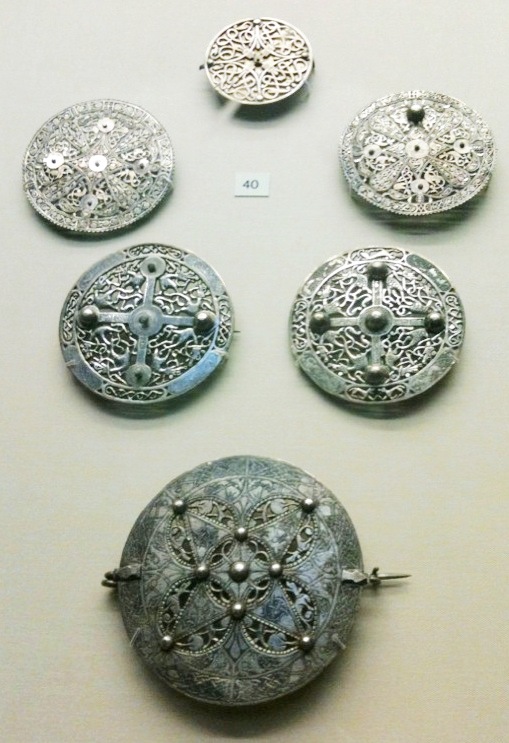 |
From Ireland, there was Saint Cuileáin's bell, and silver irish brooches, gold Viking jewellry, 'hoard cups' and gold rings. There were some examples shown of Celtic artifacts, bearing their distinctive curvilinear patterns, and many showing red enamelling amongst the metalwork, and even from Saxon sites, evidence of trade with the Celts in the form of copper hanging bowls which were in fact prized by the Saxons.
Lastly of this part of history, there is a collection of Frankish artifacts, and silver-ware from the Martynivka hoard.

One other area of this room which attracted attention is a selection of artifacts that predate the vast majority of ancient human history, starting with the oldest piece in the entire British Museum, a rouch handaxe from 1.8 million years ago, followed by selection of other handaxes through the ages until more sophisticated tools replaced them, some examples of which include a 1.2 million year old volcanic rock handaxe from Olduvai gorge in Tanzania, 1 million year old, a quartzite handaxe of around 1 million years old from near Chennai, India, and a large selection of flint handaxes from Europe, mostly Britain and France, dating between 600 000 and 50 000 years old. Past that, there is a very interesting tool, a spear thrower with a mammoth carved in to it from Montastruc France, dating around 13 000 years old. A wolverine carving pendant from Les Eyzies France; The oldest art from Wales which is carvings in a horse jaw bone, from Kendrick's cave; Finally the oldest ivory carving, of swimming reindeer, all of which also date to arounbd 13 000 years ago. The final piece of interest is the oldest depiction of one of humanity's greatest pleasures, a calcite piece called 'Lovers' depicting two people in an intimate position, dating to around 11 000 years old.
 |  |
 | |
This was a very interesting room, with a myriad of exhibits that has been barely covered in this review, and is recommended for any visit to the British Museum.
Images courtesy of the BBC, and the British Museum websites.


