Showing posts with label London. Show all posts

Friday, 30 March 2012

V&A Rennaissance in Europe, 1400 - 1600

Location: Victoria & Albert Museum, London

The V&A, as it is better known as, lies almost adjacent to the Natural History Museum and the Science Museum. Following the same style of building as the surrounding area, but taken to a grand level, this impressive place offers nothing of what is inside.

The museum was founded in 1852, it houses one of the largest collections of art in every single medium, from all corners of the world, and from all of human history. Named after Queen Victoria and Prince Albert, the museum has 143 galleries, and it is one or two of these that is the focus of this post.
The museum houses artifacts collected or donated from around the world, and are organised by region and era that they came from. So this visit introduces an interesting room in the museum, the Rennaissance Europe, from 1400 to 1600. While not covering the entire collection, this review takes a sample of one of the many rooms on offer, in a long hall with a high arched glass roof. The room is a tasteful cream colour, with dark marble columns at each end.

Starting at one end of the room, the most immediate artifact is a large stone well head decorated with the arms of the Concoreggio family, dating to 1450. Nearby lie the stemma and roundels of various family arms, such as Réne of Anjou; the roundels are of classical heads, intricately made of ceramic.
There are some statues on the other side of the room, depicting characters from classical Greek, Roman mythology, and biblical heroes. Some notable examples woulb be Jason with the Golden Fleece, Samson slaying a Philistine, and the Rape of Proserpina. The statues show the Rennaissance tendency to the dramatic in depicting classical and biblical scenes, but the Jason statue shows a more calm, satisfied scene of Jason with his Golden Fleece.
Moving past these to the wall, there are a number of interesting architectural and decorative pieces. Some of these would be a doorway, though little other information was given, top of a Dormer window, balcony panels from the Palazzo Pola, and a Dormer window from Montal, all dating from 1490 to 1557. These were attractive pieces that intrigued the author's attention in depicting how the streets of those times would have looked, with that distinctive architecture.
More statues are found around this point, amongst a plethora of capitals (column heads) and well heads, in the style of the Rennaissance families of Italy. Of these, there is the highly intricate and delicate looking fountain surmounted by a small statuette of David, matching and adjacent statues of Apollo and Zephyr, and one of Saint George and the Dragon.
The last few exhibits in this sections are of a morbid nature, starting with the oddly-shaped tombstone of Antonio and Caterina Maggi de Bassano from 1520, the grand Monument of the Marchese Spineta Malaspina, funerary chapel doorways, and a selection of richly carved effigies such as Don García de Osorio and Doña María de Perea. Finally, worth looking at is the tomb for a member of the Moro family.


The next half of this unfolded in a distinctly christian theme, with the room filled with exhibits from a number of churches, monasteries, and abbeys. For example, as labeled, some very good altarpieces to view include the 'Life of the Virgin', the 'Virgin, Child and God', with the 'Adoration of the Shepherds', the distinctly vandalised Sutton Valence altarpiece, and lastly the Troyes altarpiece. 


Stained glass windows are dotted around and illuminated, such as the Mariawald windows, windows showing St. Peter and St. Paul, and many others around the edges of the hall. Statuettes are also a prominent feature of churches, and in line with this is a collection of many such statuettes of figureheads. One set of statuettes all feature St. Catharine of Alexandria, St. Peter, St. Paul, and St. Ursula. There was a semi-decayed wooden statuette of the Angel Gabriel, then there was St. Margaret and the Dragon, and finally St. Peter again. While not exhaustive at all, these are some particular examples that should be regarded on any visit.


There was a large altar frame around a painting of the Virgin of Soreto with St. Jerome. The end of the room contains an altarpiece and tabernacle from the Santa Chiara Chapel which dates back to 1400. Behind this, there is a selection of other church artifacts of an even richer nature, such as the expensive metal pieces, incense holders, chalices, candlesticks, and metal altar crucifixes. On the other side is a selection of the fine cloth and robes worn by members of the church, including a selection of various mitres.


This concludes this particular section of the V&A museum, and there will be many more visits to come, especially in this area which offers so much for the visitor to see. Photographs are courtesy of the author himself, once he finally worked out how to download them to his computer!

Wednesday, 8 February 2012

London in the snow

Location: Arsenal, Highbury, Islington, London Bridge, Tower Bridge, London

Warning: This post contains judicious image usage and dry humour.


This is an event that occurs fleetingly at any point during the year. Large quantities of settled snow like this are unexpected to say the least, and only up to a week in advance can forecasters predict it with even moderate accuracy.
Usually remarked as a time of intense cold, slippery pavements and infrastructure issues, the tone of this is to bring out the reason against staying inside in comfort. It is something that should be embraced for its sudden appearance, and disappearance soon afterwards, as something that brings joy to children, even childish adults, for fun games, and spectacular views.

In this case, here is a gallery of photographs taken on a trip from North to Central London.

One of the many snow-covered streets in Arsenal.

One view of the Unity church in Highbury

Islington green, not so green.

View of the incomplete Shard tower at London Bridge. Currently the top is obscured by the low cloud.

The North-west side of the Tower of London.

Far off view of Tower Bridge along the side of the Tower of London.

View of one of the docks in St. Katharine's Docks

Some of the larger boats in the St. Katharine's Docks

A large yacht.

View over another dock.

A more side-view of Tower Bridge.

A view down Tooley street. In many of the busier streets like this, there was hardly any snow left by Noon.
A peek out from the South bank, across the Thames. The footpath along the Thames was very snow-covered.

Looking back at Tower Bridge from the same bank as the previous image.

While hardly snow-strewn, the Hay's Galleria always makes itself presentable for the budding photographer in London.

Statue supposedly of Julius Caesar. This is found right by the Tower Hill tube station.
All these pictures were taken on a mobile phone camera.

Tuesday, 7 February 2012

London pubs: Dicken's Inn

Location: Dicken's Inn, St. Katharine's Docks, London

From the outside, this large venue stands out with a distinctive style from times not so long past. It has a history nestled in the heigh days of the Thames as a major trade route, having once been a warehouse further up the river. According to the main website, in the 1820's the building had a brick exterior built up around it, which hid the remarkable timber frame until the 1970's. During this time the building was carefully deconstructed and the timber frame was moved to its current site, where it was reconstructed to the public house that it is today. An array of framed photographs of this event hang just within the entrance, with a plaque below to commemorate its reopening in 1976.

The front of the building gives of a very welcoming vibe, standing out from many other places for the effort put in building up this appearance. Behind a small beer garden to the groundfloor terrace, the railing lined with flowerboxes which are full of bright flowers in Summer.

Above it, one can see two more floors of terraces, all spreading out across the entire front, and one can almost imagine how appropriate an image this gives of a busy drinking house in warmer evenings, with the clientele standing, leaning, all having a pleasant evening. However in Winter, the outside is much quiter and more subdued for the lack of bright colours, but hardly seems diminished in its impression to the potential visitor.

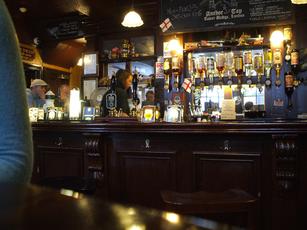
Inside, on the groundfloor, the place is fairly dimly lit, and invitingly warm despite the outside cold. The bar is immediately in front, and stretches out for a considerable length, with a brassy top, and shelving across the bricked walls, which are lit up to display their wares. The beers here are more of the standard variety of London lagers and ales, but do offer the casual drinker a wide choice to choose from.
The next noticeable aspect of this floor is the impression of a low ceiling, which is more illusory, from the large beams running over the darkwood floor for the entire length of the building, with plenty of seating available, high stools and tables in the middle, more cushioned armchairs and sofas with low tables at one end, eventually dining chairs and tables at the other end, all mark out the main bar area of the venue. There are a few television screens around showing sport, and music plays at a comprise between being a presence and background noise, never giving out an impression of quiet solitude. Timber columns here show the thickness and quality of wood used for the old frame, and run intermittently along the building, going up through every floor to the roof.


Last detail worthy of note here is written on some of the beams, a selection of quotes, mostly drink related, and from a variety of sources, with an example below:
“Did you ever taste beer?” “I had a sip of it once” said the small servant. “Here's a state of things,” cried Mr Swivvler, “she never tasted it – It can't be tasted in a sip.”
from the Old Curiosity Shop.

The first and second floors are the main dining areas of the pub, each displaying the style of food they serve and as such giving off distinct impressions to relate to the diner.
The first floor is the pizzeria, with lighter coloured furniture and décor, to bring out a lighter vibe to go with the pizzas they serve. The second floor is the grill, with dark wood furniture, and the smell of grilled meat in the air. This floor also has a feeling of greater space, with the roof stretching out high over the top, white panelling between the numerous beams, smaller beams between the larger ones, giving an almost barn-like appearance, revealing the upper structure of this historic place.
Again, with both floors, they shared another feature with the open front kitchens, showing the food being prepared and served in full view of the waiting customers and new customers waiting to be seated.

This concludes a review of the Dicken's Inn. A remarkable place to go for a drink, with a warm atmosphere, and with plenty of space to relax in. It is recommended for anyone who wishes to go, including solo drinkers, but it stands out for groups of people, and parties. The location itself is excellent, having the surrounding docks with a plethora of boats of the rich and famous, lines of shops and some restaurants dotted around in tasteful brick buildings, and not least, the docks' proximity to Tower Bridge and the Tower of London.

Pictures from the author and the Dicken's Inn website.

London pubs: Anchor Tap, & Horniman at Hay's


Location: Anchor Tap pub, London


From an unassuming exterior down a side street near to Tower Bridge, this public house retains much of the character of its age. While finding details on its past is sketchy, the pub was run by the Courage Brewery from 1787, when the Anchor Brewery closed down, to 1981 where it has since been run by the Samuel Smith's Brewery company.

Through the front door, one is greeted by a venue from a time long before, with a dark murky feel from the cream and brown patterned walls, and lots of dark wood panelling. The furniture itself is mostly of a dark wood, blending around the sides of each room of this deceptively expansive place.
Past the first bar area, to the right is a larger room, with more furniture for drinking on, stools and chairs surround the front sides of a variety of circular or rectangular tables, with the walls lined with cushioned benches. Even a piano offers itself as a surface, with a line of stools along its front, and a smouldering fireplace in the corner.
The walls of the room are covered in a wide array of black and white photos, hinting at the long history of the place, showing scenes of the street outside, and of the Thames river, elaborating on the history that London has as a once major port for sea trade.
Moving on, the games room is smaller by comparison, with more of a murky dark appearance despite the increased light from a large window, containing some furniture and a couple of games machines on one side.
In keeping with this theme is a back room of similar size but more square in shape, lighter décor and lighting is used in this room to provide the required lighting over the central pool table, while benches line the sides for onlookers.
Last on the downstairs is the lounge room, where the décor is lighter in colour than the rest, with more comfortable seating around low tables, the armchairs covered in patterned cushioning.

Going upstairs, one is greeted with the dining area, which consists of three rooms, the smallest of which is separate from the other two, while the largest contains the upstairs bar in one corner. The rooms are outfitted with laid out dining tables and comfortable seating, fully-cushioned benches and armchairs, their patterns introducing a pleasant shade of green to the surrounding colours.

An extremely pleasant pub overall, though very quiet on a Sunday, with a good amount of room for a backstreet venue. It offers a certain solitude away from the bustling crowds of Central London, and nearby, a short stroll to the Thames path for a walk along the Thames bank.

Images by the author, and BeerintheEvening.

Location: Horniman at Hay's, London

A good sized pub just off the side of Hay's Galleria, which is a very tall arcade with a good twist of Victorian décor, and even a steampunk statue in the center. The entrance itself simply takes the visitor right in to the thick of the atmosphere where the brightly lit bar area greets one, and a rich assortment of colours and styles create a seemingly decadent feel to it. One does indeed feel like they have stepped in to what a gentleman's club would have appeared in Victorian times.


There are cream coloured walls, dotted with gold framed hangings, gold-coloured trimmings and theatre-like decorations for the ceiling. Several chandeliers hang down over the bar area, highlighting the colour of the wood much more brightly, while moving further in, one will find that it is more dimly lit, there the staircase leads one up to the mezzanine dining area.


Walnut-coloured wood panels, railings and shelving behind the bar makes a change from the usual dark wood, while murals line the walls above the bar, and along the outer edge of the mezzanine, depicting scenes of Britain's seafaring and colonial history in exotic locations.

The bar contains the usual set of lagers that many other pubs have, along with a few common ales found in London. However it does also contain some guest ales and Belgian beers.
The locale is warm inside, and evidently it is frequently busy, even during Sundays. Recommended as a place to relax with company, and to try whatever ales there are available.

All pictures done by the author.

Saturday, 4 February 2012

Visions of Earth, and other Galleries, Natural History Museum


Location: Natural History Museum, London

This visit to the Natural History museum was the first such visit for over a decade for the author, and as such, not only were a few of the galleries reviewed, unintentionally, but there are more plans to try and give a complete overview of the museum in subsequent visits.

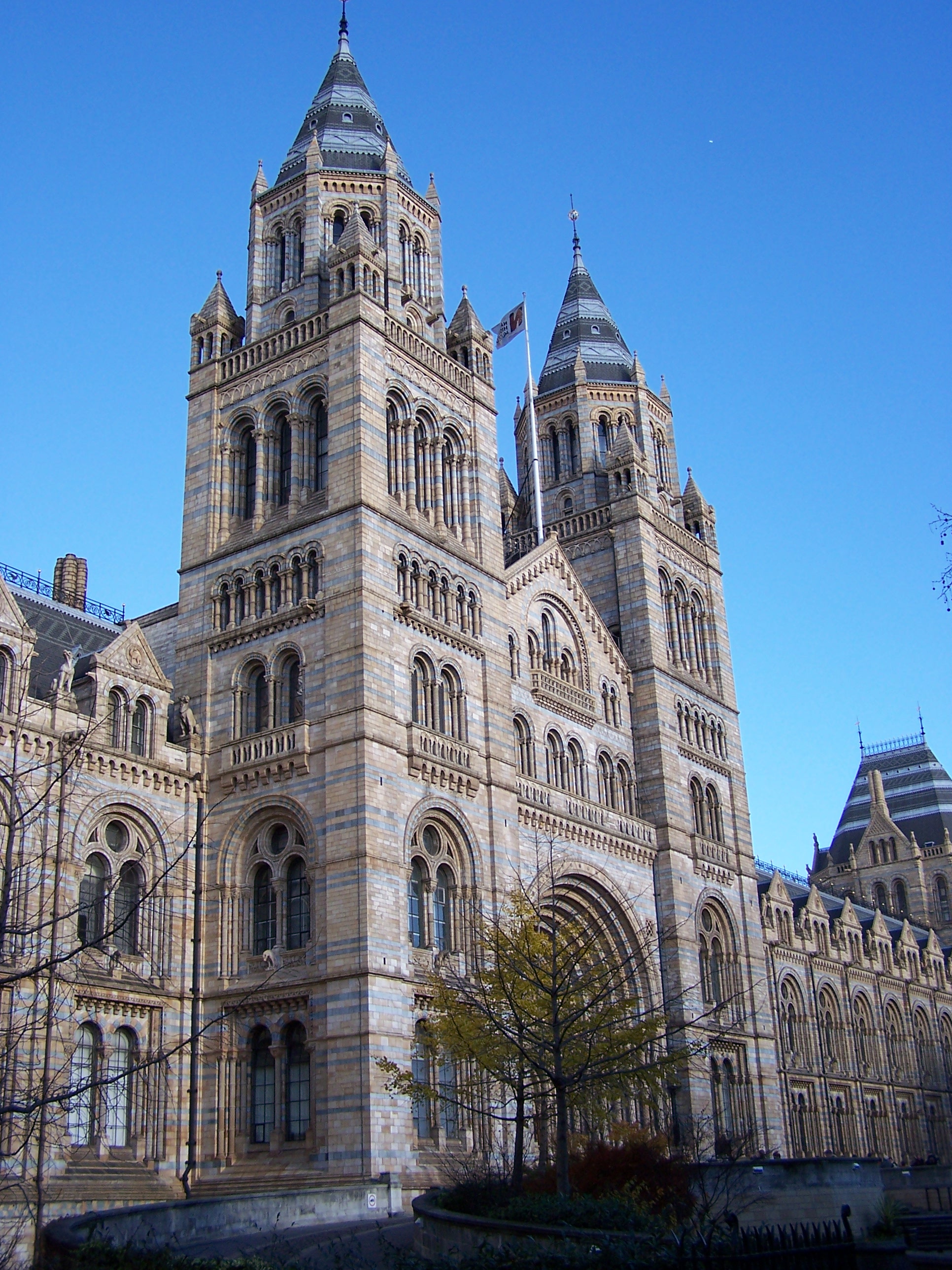
First impressions are one of the museum's strongest, the large building stretching out where one stands at the front, exquisite architecture over the entire facade, especially featured are round arches over the doors and every window. The building is composed of sandy coloured bricks, interspersed by patterns of grey bricks. The location itself is memorable, situated in one of the most affluent areas of London, by South Kensington station, and adjacent to both the Science museum, and the V & A museum.

The review, situated on the east side within a newer extension of the main building, is in the red zone, and begins with the gallery “Visions of Earth”, opens on a room with six statues lining a corridor through; Some notable ones being Zeus, who had a selection of hand-axes to illustrate the first humans in Europe around 400 000 years ago, Medusa, the aspect of petrification with a selection of petrified life as the ancient greeks would have seen, including a large fossil, and a cyclops, highlighted that the origins of which would have been from the skull of a Mastodon.


The walls of the room are lined with small 'peep-holes' containing examples of gemstones and other interesting rocks, as well as some explanation of their use and perceptions by humans. Through the middle of all this, an escalator goes up, through the middle of a large metal structure of the globe, humourously playing metal music inside, and leading onwards to more connected galleries including the “Restless Surface” and the “Power Within”, all giving a view in to the massive range of expressions that show how dynamic the surface of the Earth is.

After the escalator, one is greeted with a dark room, and side exhibits leading the visitor through, first showing some large rocks and how they were formed by the simplest of geological forces as a set of adjectives, 'forcing', 'squeezing', 'shattering', and more. Next was an exhibit highlighting the number of volcanoes and earthquakes around the globe, a screen shows the number of recent earchquakes and their magnitudes, to a series of images, showing the Earth's continents as they were 250 million years ago, today, and in 250 million years in the future.
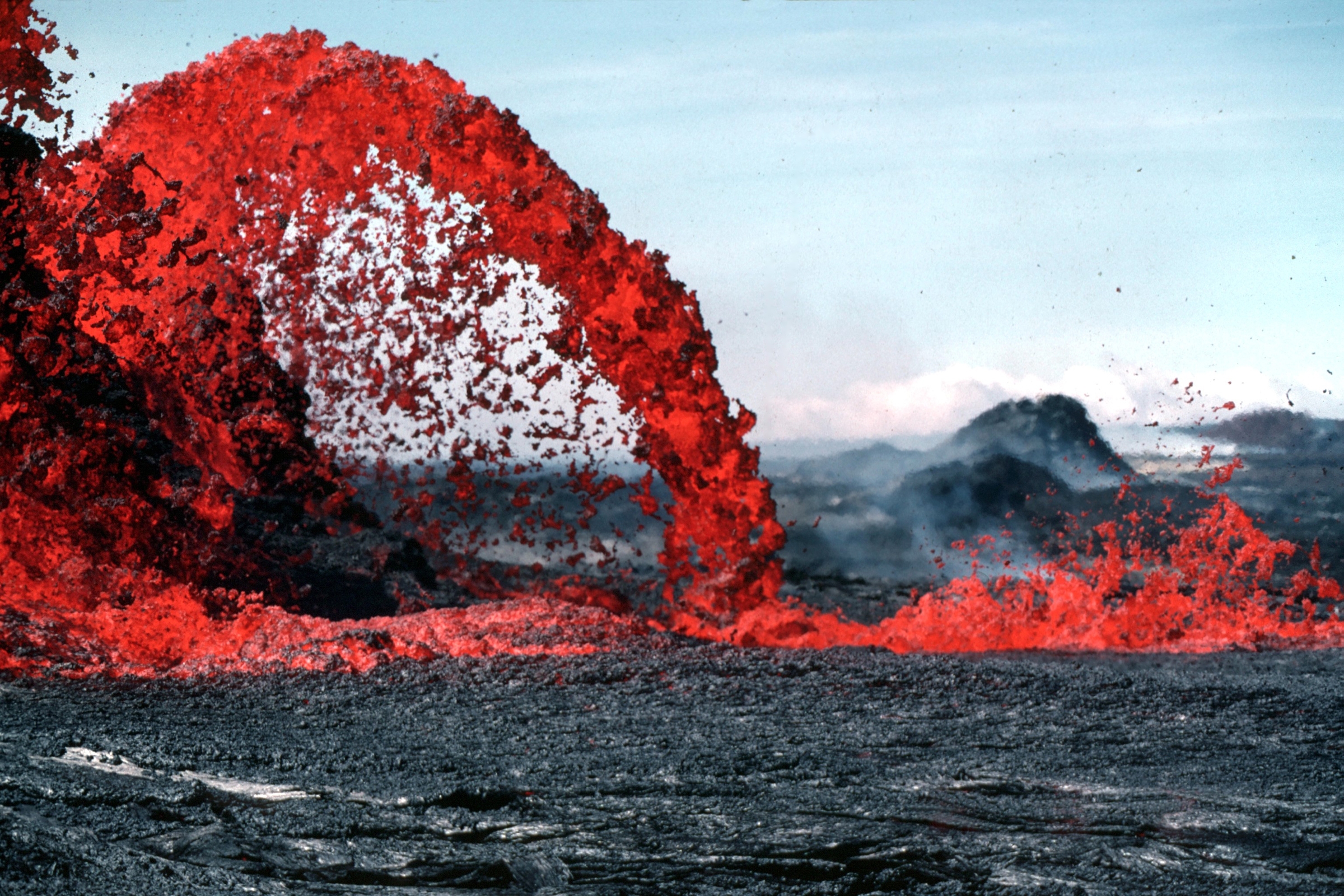
The next area began with showing the eruption of Mount Pinatubo in the Philippines, and the resulting effects on the local people, including the death toll of 800 people despite an evacuation prior to the eruption. Moving further in, there was a range of displays of the different types of lava and their solidified forms, including the well known runny lava flows, pahoehoe, and the incredibly delicate looking Pele's hair. Many more besides, it shows the range of types of rock and volcanic glass formed from various types of eruptions.


Spray of pahoehoe lava.Pele's hair
This leads in to another dark room, a circular area with the center filled out by a statue of a magma core that form below volcanoes. Round this is a summary of the internal workings below the surface that precede volcanic eruptions, and around this, are other examples of volcanoes that impacted on humans, from Mount St. Helen's, Mount Pelee in the Caribbean, and Mount Vesuvius.


Moving on, one eventually comes to a section on earthquakes, with a summary of how they are caused, along with an illustration of the Richter scale, and even a vibrating room to demonstrate the effect of the Kobe earthquake.

The rest of the exhibits trail on through a variety of other displays of geological forces, moving to surface level weathering forces such as wind, water, ice, and the chemical weathering forces. Here a lot of time can be spent with the variety of attractions, displays of rocks, and a plethora of images and television screens.


This was an excellent tour, with plenty of tactile and visual attractions that appeal to both children and adults to educate one in the vast range of forces and effects that the Earth displays, ranging from the passive sedimentation and compaction forces, tectonic shifts, to the more violent shows of volcanic eruptions and earthquakes. This is by no means a comprehensive guide, and only half has been given in the review above. For the lone visitor, the weekend is a better choice in order to avoid the numerous children on school trips that might otherwise be busying themselves around the attractions.
Images yanked from the Natural History Museum, from Wikipedia and from another blog: Lovingthebigisland's